My Process


First, an honest note about the work you won’t see here

Almost everything I’ve made in the last ten years sits behind an NDA. The theme park experiences, the brand launches, the internal programs — I can tell you the results, but I can’t show you the work, the decks, or the rooms where the decisions happened.

So instead of a portfolio of other people’s secrets, I built one project in the open: a fictional client, a real process. Everything below — the strategy, the concepts, the naming, the pitch, the team — is how I actually work, applied to a project that never happened. If you want to know how I think, this is the truest thing I can show you. My best work may be under NDA, but my thinking isn’t. 

One mock project below — but the process isn’t a placemaking process at all.

What follows is a single worked example: a botanical garden’s first nighttime experience. I chose a place because places show the work clearly. But the sequence you’re about to see — business needs first, strategy in one sentence, honest options, a name that carries it, a pitch that recruits believers, a team cast on purpose, a launch watched with clear eyes — is the same one I run on a product launch, a brand refresh, an internal program, or a season of content.

Different deliverables. Same discipline.

The mock project: Marisol Bay

Marisol Bay is an invented coastal botanical garden — beloved locally, busy on spring weekends, quiet the rest of the year. The invented brief: create the garden’s first nighttime experience, something that gives locals a reason to come back monthly and gives visitors a reason to stay in town after dinner.

That’s the brief as it would arrive. It’s never the real brief.


1. Understanding the business needs — where every project starts

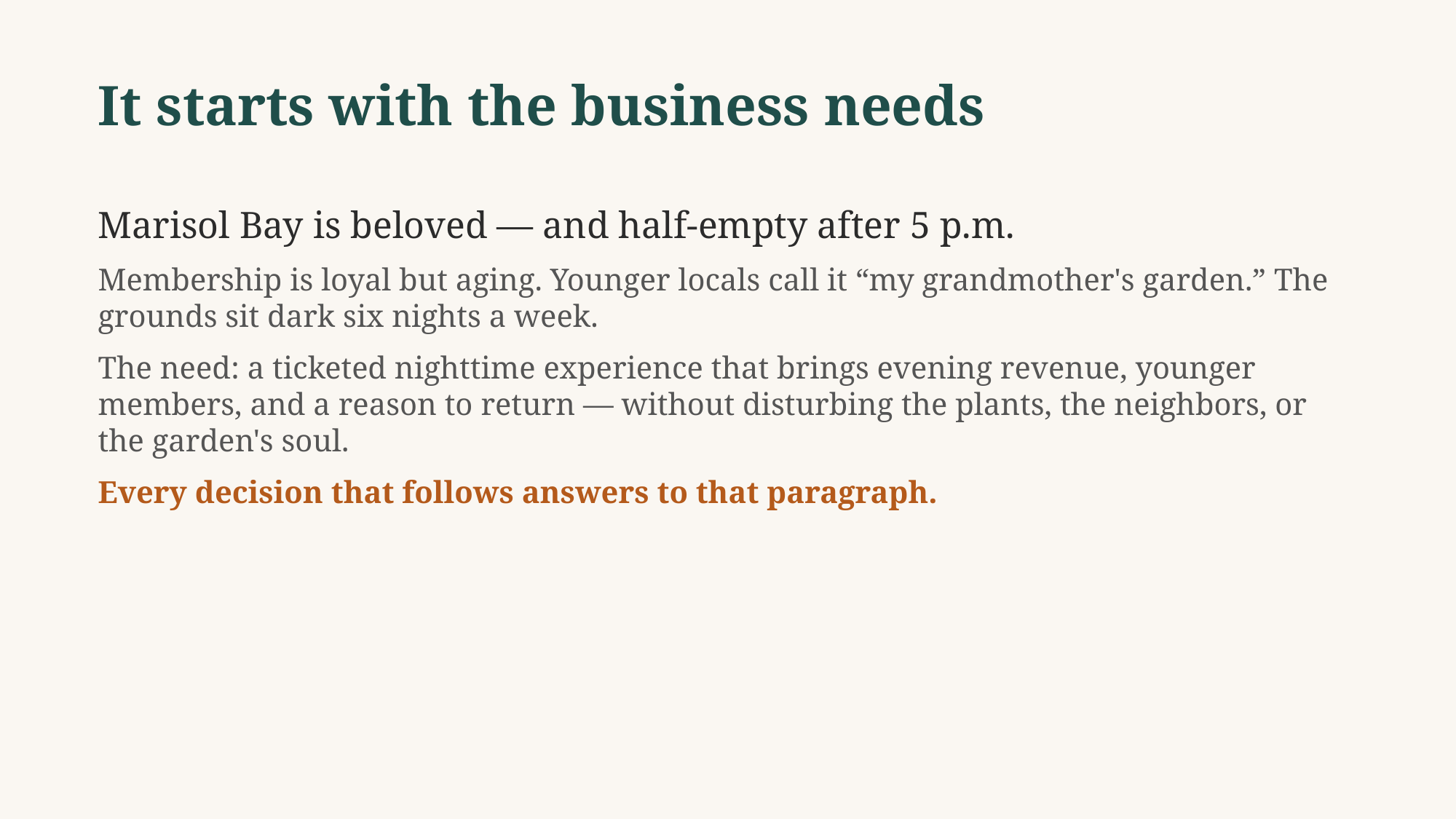
Every project I take on starts in the same place: understanding the business needs. Before concepts, before design, before anyone opens a sketchbook, I ask questions until the business problem shows itself — because the creative work only matters if it solves the right problem.

For Marisol Bay, the surface ask is “a night event.” The real business needs underneath it:

  • Revenue stops at 5 p.m. — the garden’s best asset sits dark for half its usable hours.
  • Locals visit once a year out of obligation; there’s no habit to build on.
  • The garden competes with dinner and a movie, not with other gardens — so the experience has to win an evening, not an afternoon.

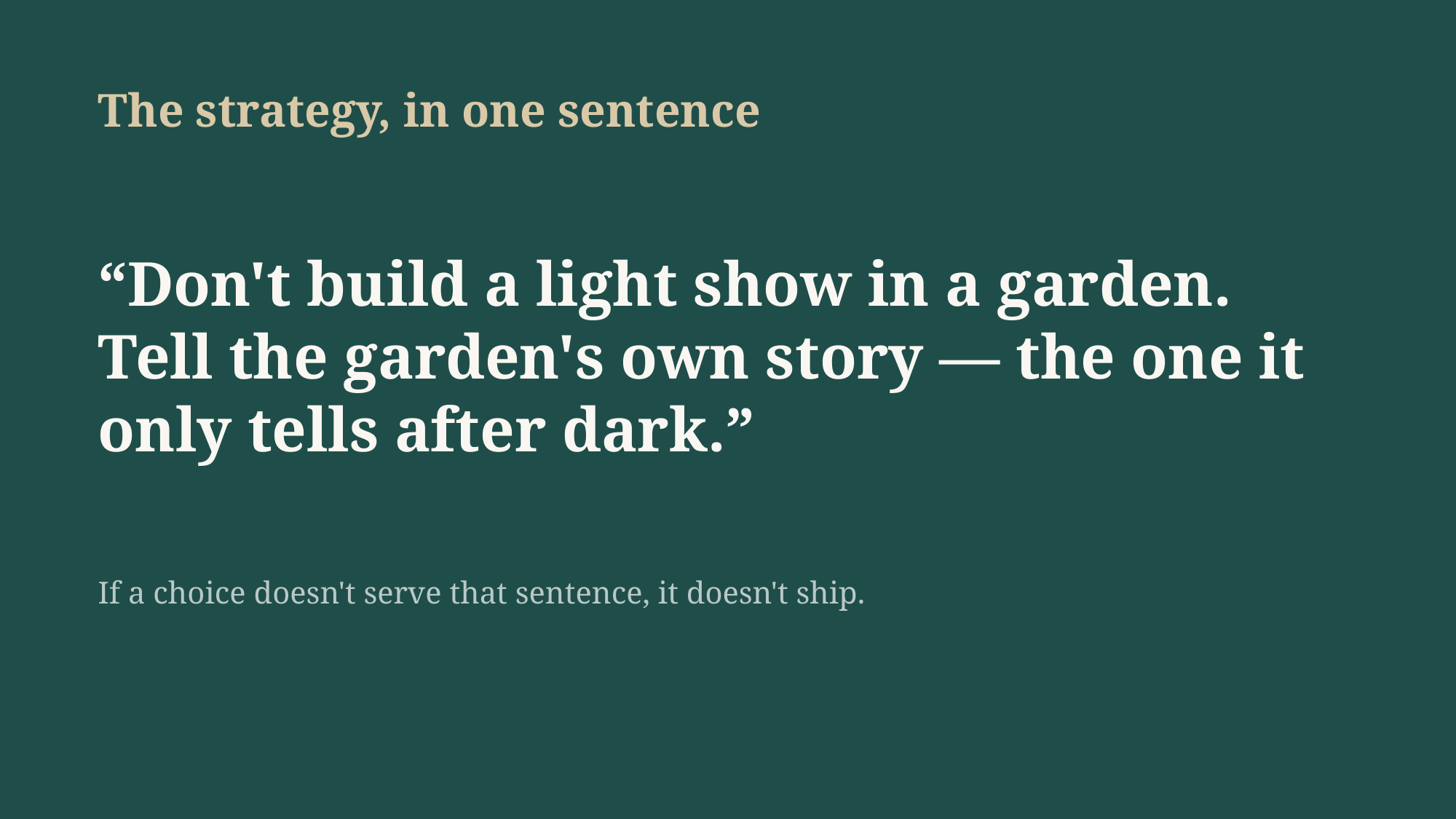
The strategic decision that comes out of that conversation: this isn’t an event, it’s a second front door. Everything after — concept, name, team — hangs off that sentence. If I can’t say the strategy in one sentence a board member could repeat in an elevator, we’re not ready to design anything.

2. Insight and audience – who is this actually for?

I build for specific people, not demographics. For Marisol Bay, three audiences, in priority order:

  • The local couple who’ve “done” the garden — they need a version of it they’ve never seen.
  • The visiting family deciding how to spend their one free evening.
  • The garden’s own members and donors, who need to feel the place is alive and worth supporting.

The insight the whole concept leans on: a garden at night isn’t a darker garden. It’s a different place — quieter, stranger, more romantic. The design job is to protect that feeling, not pave over it with spectacle.

3. Concept approaches – options with real differences

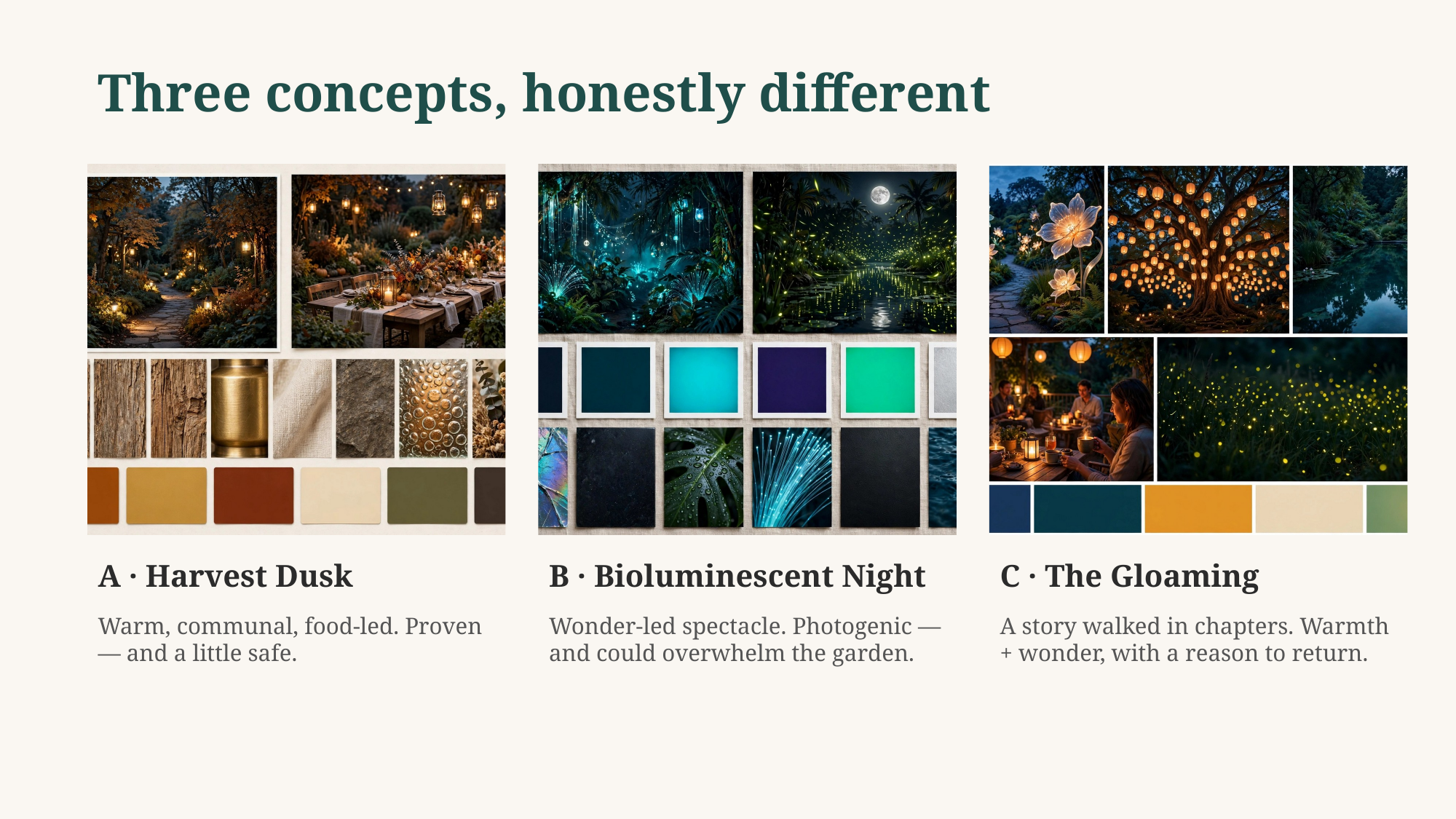
I always develop concepts that are genuinely different bets, not three costumes on one idea. Each gets a mood board, a one-line promise, and an honest downside.

Option A — “Harvest Dusk.” Warm, communal, food-led: long-table dinners among the beds, lantern light, harvest menus. Promise: the garden as the town’s dining room. Downside: it’s a restaurant with better scenery — hard to scale, weather-exposed.

Mood board — Option A: “Harvest Dusk” (amber, lantern light, long tables, autumn botanicals).

Option A, specified — Palette: burnt amber #B45A1B · harvest gold #D9A441 · deep rust #8C3B22 · warm cream #F3E7D3 · olive #6B7248 · charcoal brown #3B2C22. Finishes: weathered oak, brushed brass, blackened steel. Textures: natural linen, rough-cut stone, seeded glass, dried botanicals, woven cane. Light: warm 2700K lantern glow, flame where permitted.

Option B — “Bioluminescent Night.” Wonder-led: glowing installations, ultraviolet plantings, a moonlit reflecting pool. Promise: the garden as another planet. Downside: beautiful, but cold — guests admire it more than they inhabit it, and it fights the garden’s natural character.

Mood board — Option B: “Bioluminescent Night” (deep teal, glow, fireflies, moonlit water).
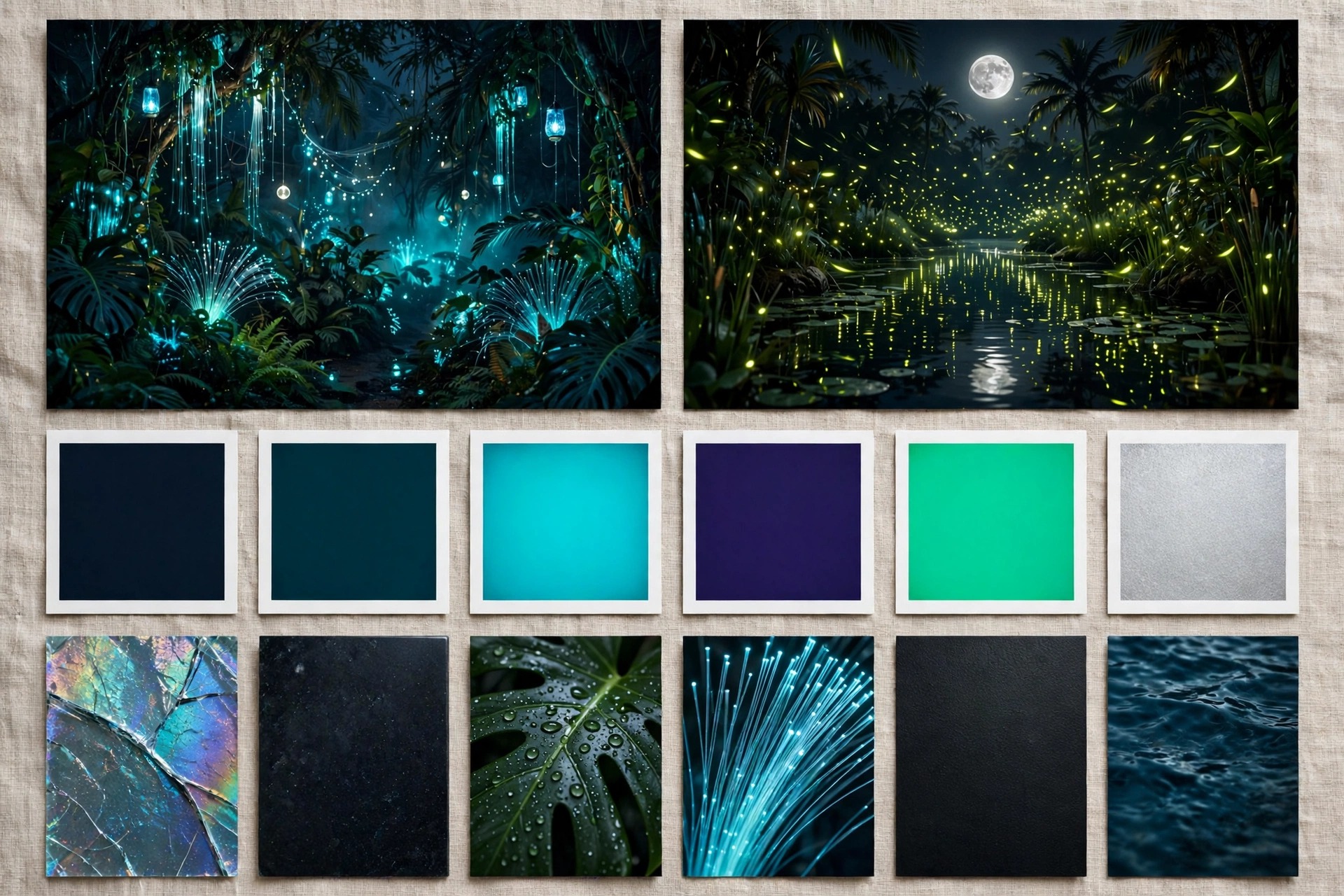
Option B, specified — Palette: midnight navy #0E2233 · deep teal #14524B · bioluminescent cyan #3FD2C0 · ultraviolet violet #5B4B9E · phosphor green #9BD147 · silver #C7CDD1. Finishes: iridescent glass, dark polished stone, matte black metal. Textures: wet monstera leaf, water ripple, fiber-optic strand, smooth river rock. Light: cool, sourceless glow — nothing that looks like a fixture.

Option C — “The Gloaming.” Story-led: a slow walk through the garden at blue hour, following a simple story — the garden waking up for the night — told through light, sound, and a handful of participatory moments. It takes A’s warmth and B’s wonder and gives guests a reason to move, linger, and come back as the story changes with the seasons. This is the option I’d recommend, and the one the rest of this page develops.
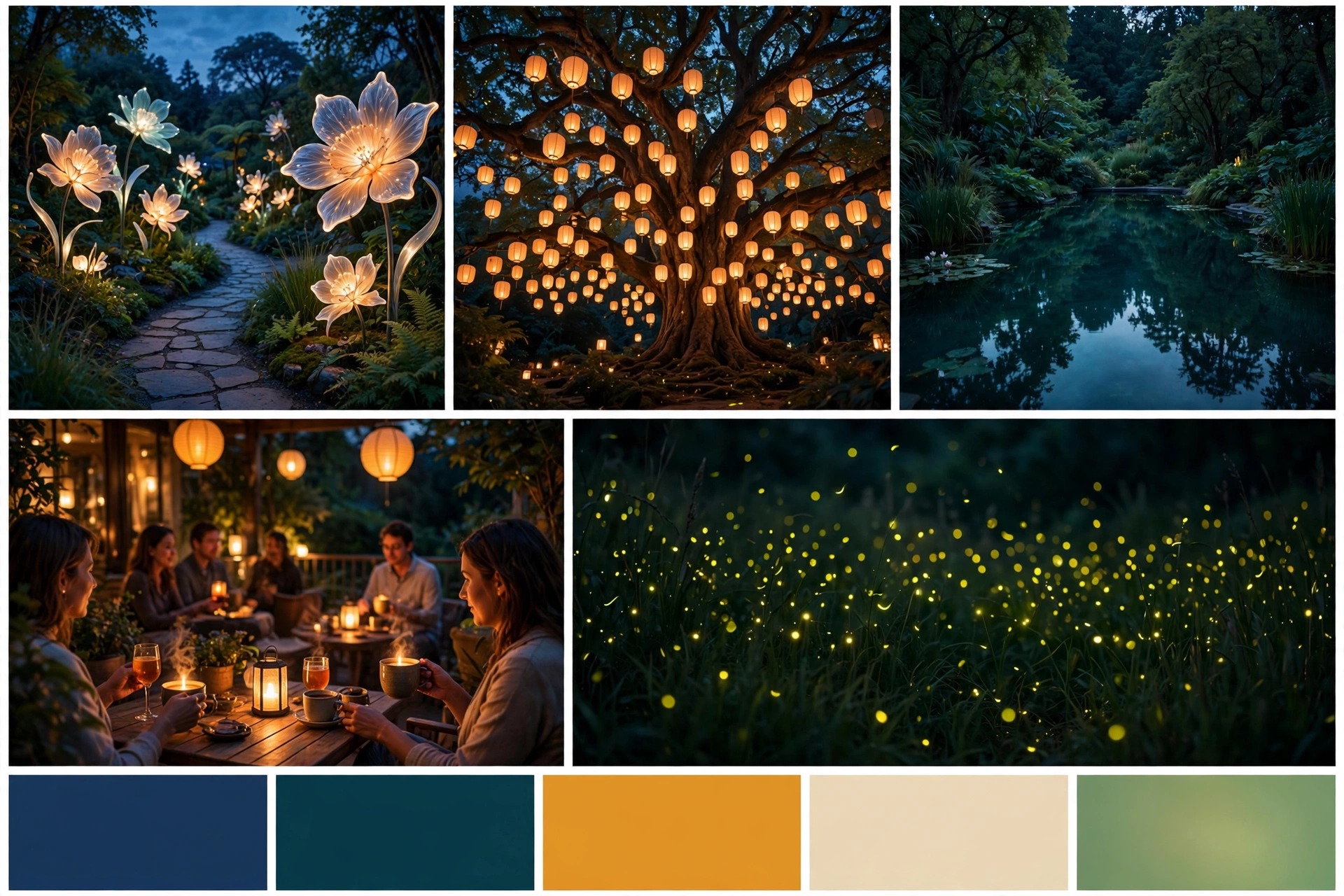
Option C, specified — Palette: the dusk gradient itself — indigo #2C3E63 deepening to teal shadow #173F3A, lit by lantern amber #E8A33D and warm cream #F6EBD8, with firefly green #A8C256 as the single accent. Finishes: brushed brass and weathered oak borrowed from A; dark stone and still water borrowed from B. Textures: linen and cane at the warm chapters, wet leaf and ripple at the quiet ones. The palette is the story: warm is human, cool is the garden waking up.

4. Naming — the smallest piece of strategy

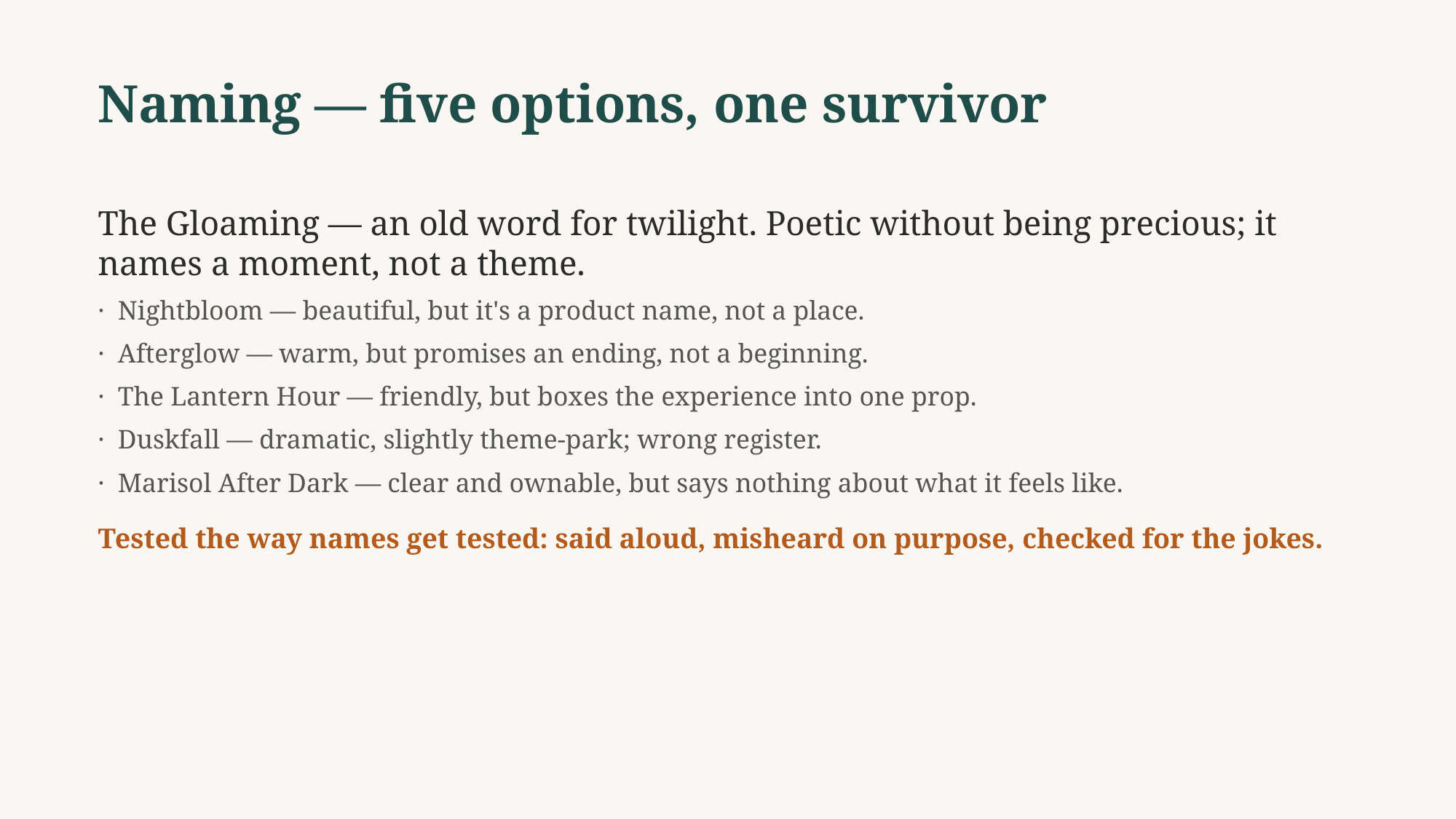
A name is the strategy compressed into two or three words, so I name late — after the concept is chosen — and I name in options, with the reasoning attached:

  • The Gloaming at Marisol Bay — “gloaming” is the old word for twilight; it promises a specific hour and a feeling, and it gives the experience a name locals can own (“meet you at the Gloaming”). Chosen.
  • The Lantern Hour — warm and clear, but it promises lanterns the design only uses in one scene.
  • Firefly Season — playful and kid-friendly; wrong signal for the date-night audience we ranked first.
  • Marisol After Dark — functional, sounds like a discount ticket tier, not an experience.
  • Lumen Hollow — pretty, and completely unconnected to this garden or its coast.

My tests for any name: Can a tired parent say it clearly in a parking lot? Does it still work when a kid shortens it? Does it describe the feeling or just the furniture? “The Gloaming” passes all three — and it names the exact twenty minutes of light the whole design is built around.

5. The pitch — rallying the room

A pitch is not a reveal; it’s the moment a project gets its believers. How I run it:

  • Lead with the guest, not the renderings. The room walks the path as a visitor for the first five minutes — what they see, hear, and feel, in order.
  • Name the strategy sentence early (“a second front door”), so every later argument has something to attach to.
  • Pre-wire the skeptics. Operations, finance, and horticulture see the risky parts before the meeting, one on one — surprises in a pitch read as ambushes.
  • Say the risks before anyone else does. Weather, light spill onto neighboring homes, wear on the plantings — naming them first is what makes the rest of the deck believable.
  • End with the decision you actually need, and what happens next week if you get it.

The goal isn’t applause. It’s leaving the room with the operations lead already solving your problems out loud — that’s when a project becomes real.

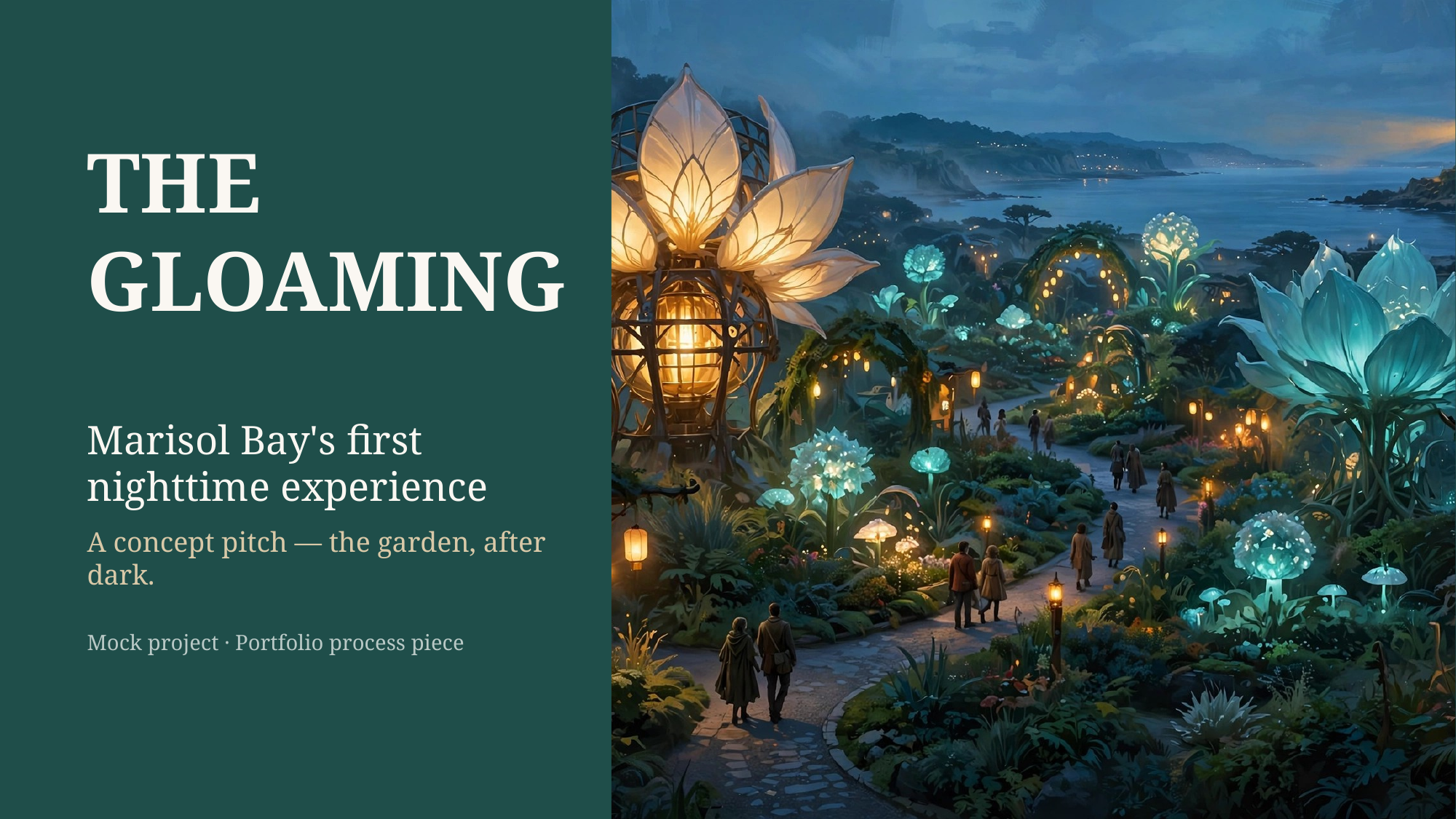
Sample Pitch Deck
6. Building the team — the right people, on purpose

Once it’s approved, the creative work is mostly casting. For The Gloaming, the team I’d assemble, and why each seat exists:

  • A lighting designer who has worked outdoors — the night sky is a collaborator, not a backdrop.
  • The garden’s own horticulturists, as co-designers, not consultants — they know which plantings can carry light and foot traffic, and their ownership protects the design later.
  • A sound designer, because at night, sound does half the storytelling.
  • Food and beverage early, not late — one warm drink in guests’ hands changes how long they stay.
  • Local artists for the participatory moments, so the experience belongs to the town, not just the venue.
  • One operations lead with veto power over anything guests can’t safely do in the dark.

And my own job on that team: first line of contact, translator between the story people and the build people, and the person who keeps asking “what does the guest feel here?” when the conversation drifts to fixtures and schedules.

7. Design development — story you walk through

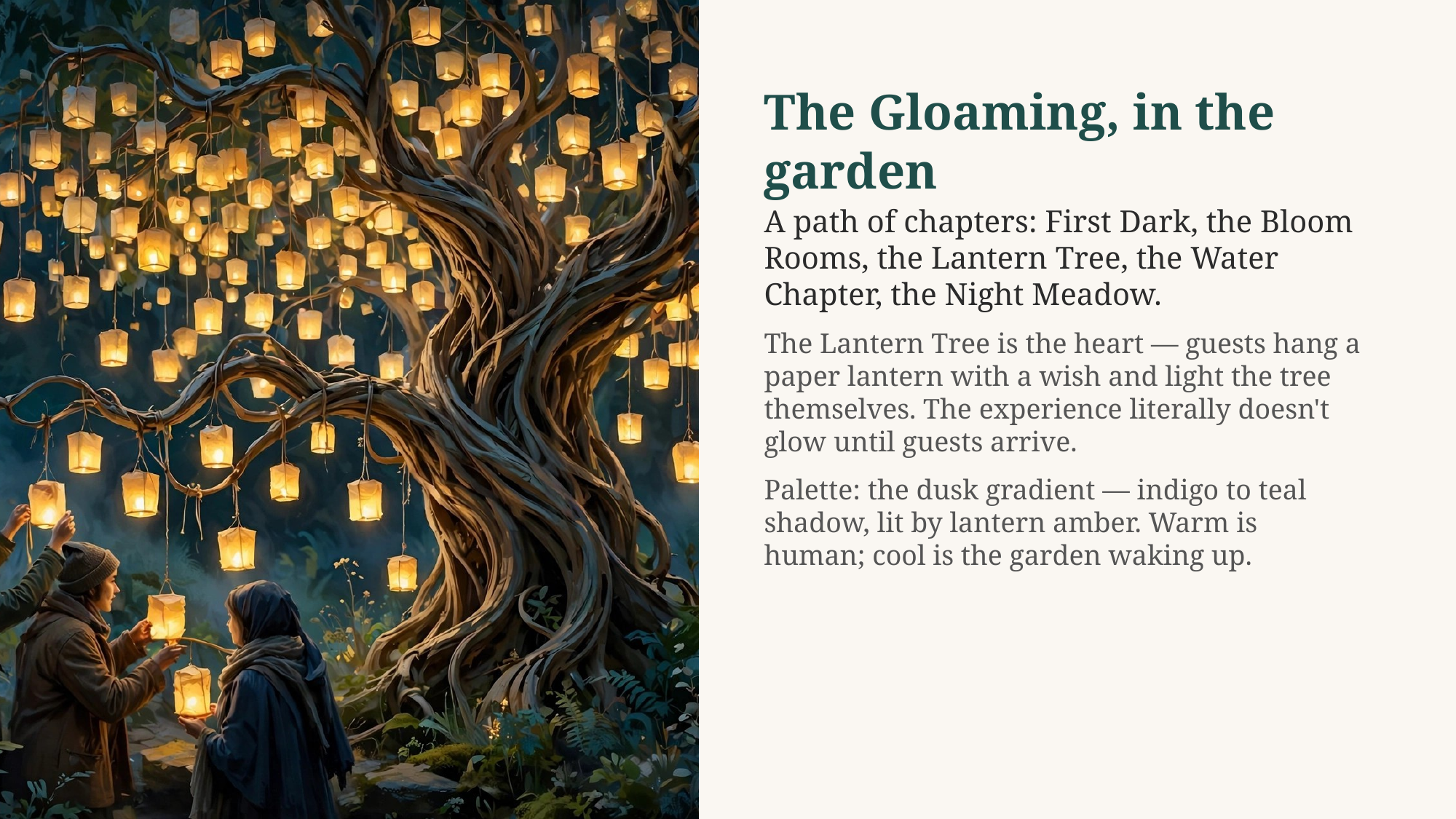
The Gloaming is structured like a short story with chapters, one per garden room: Arrival (the light drops, the city sounds fall away), First Dark (firefly-scale lights in the grasses), The Lantern Tree (the participatory heart — guests write a wish or a name and hang it among hundreds of others), The Water Chapter (the reflecting pool, the quiet peak), and Return (warm light, warm drink, the garden shop doing the best business of its year).
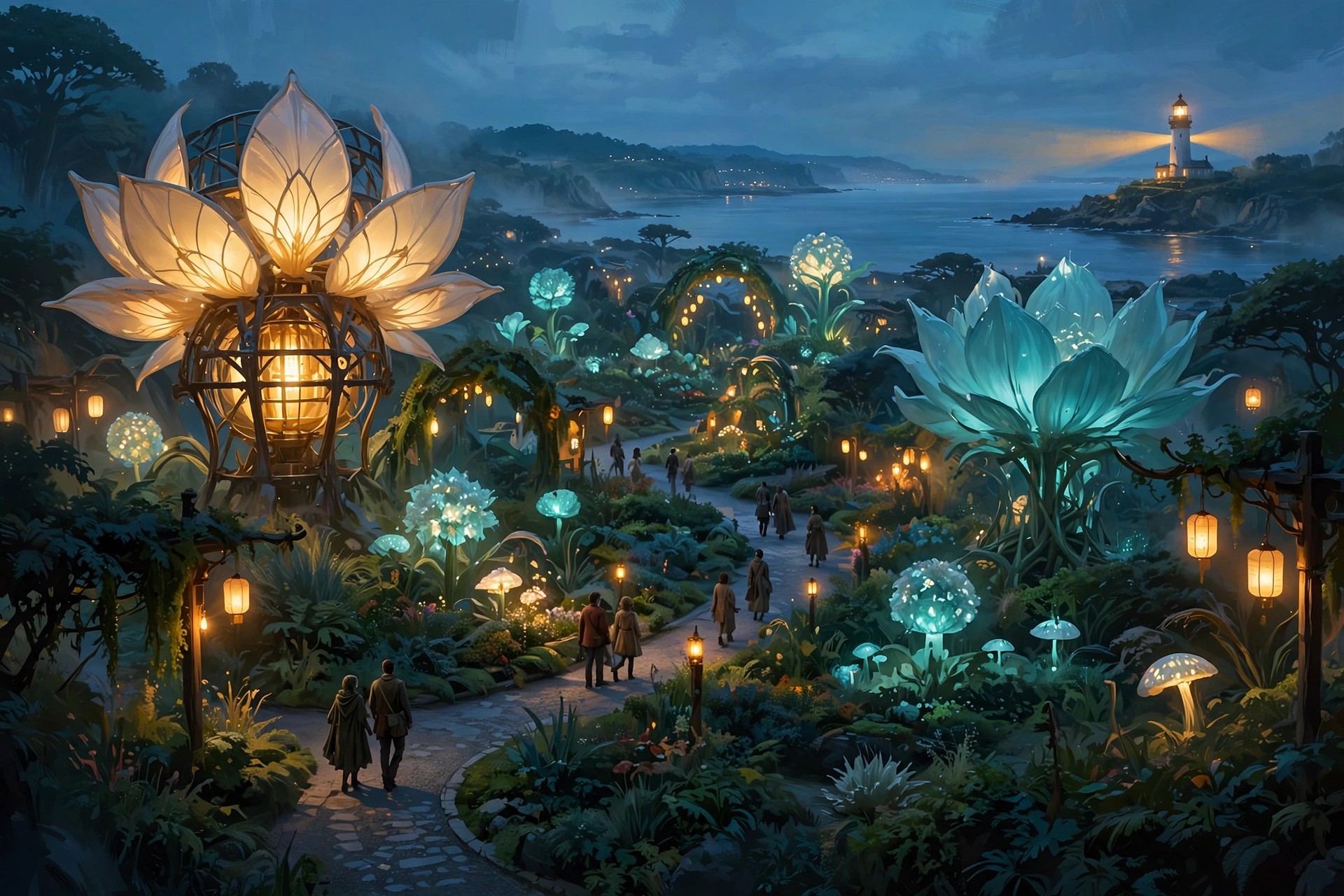
Concept art — The Gloaming: the guest path at blue hour, glowing botanicals, the bay beyond.
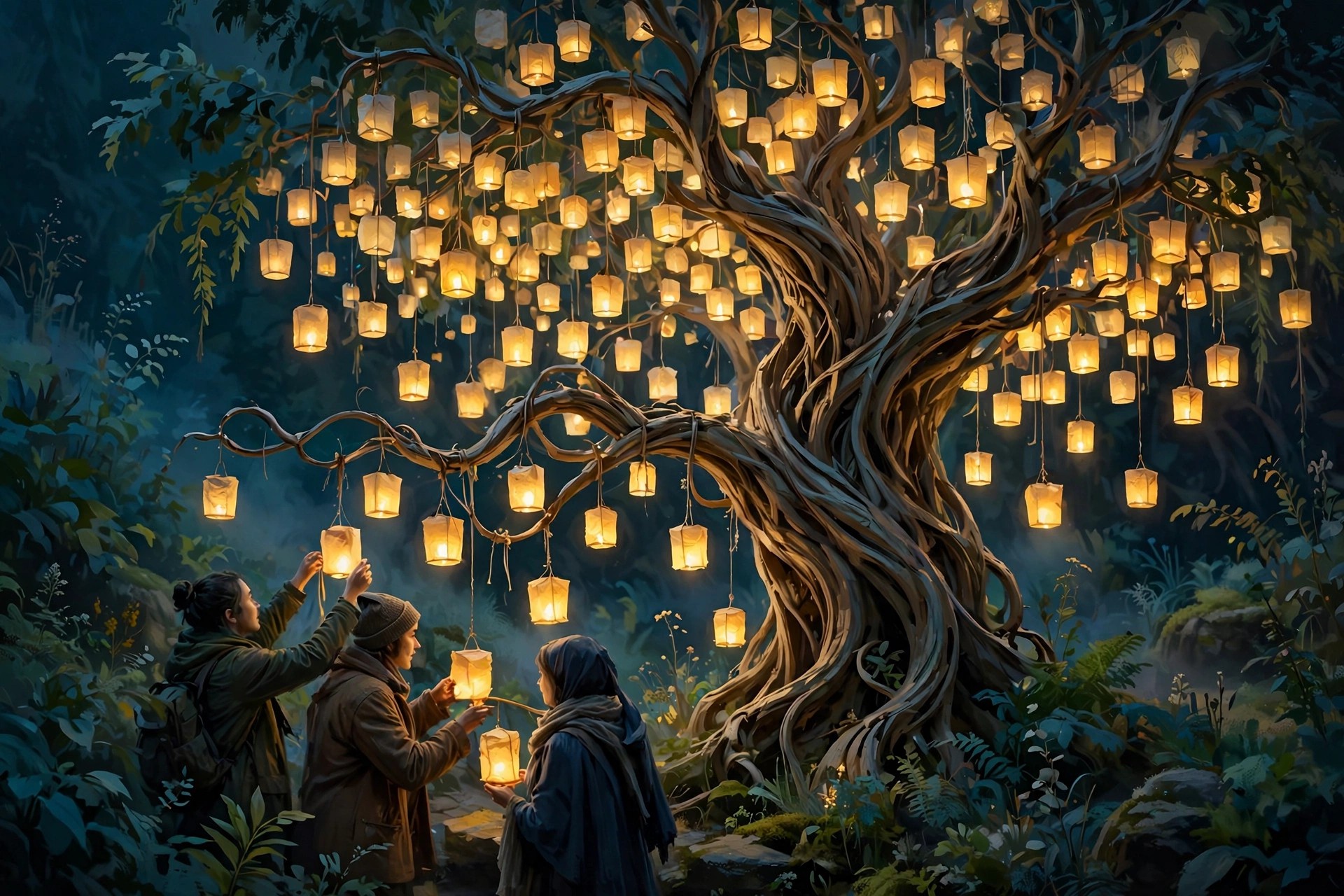
Concept art — The Lantern Tree: the one moment guests make themselves, and the one they’ll photograph.
8. The campaign — selling the night before it opens

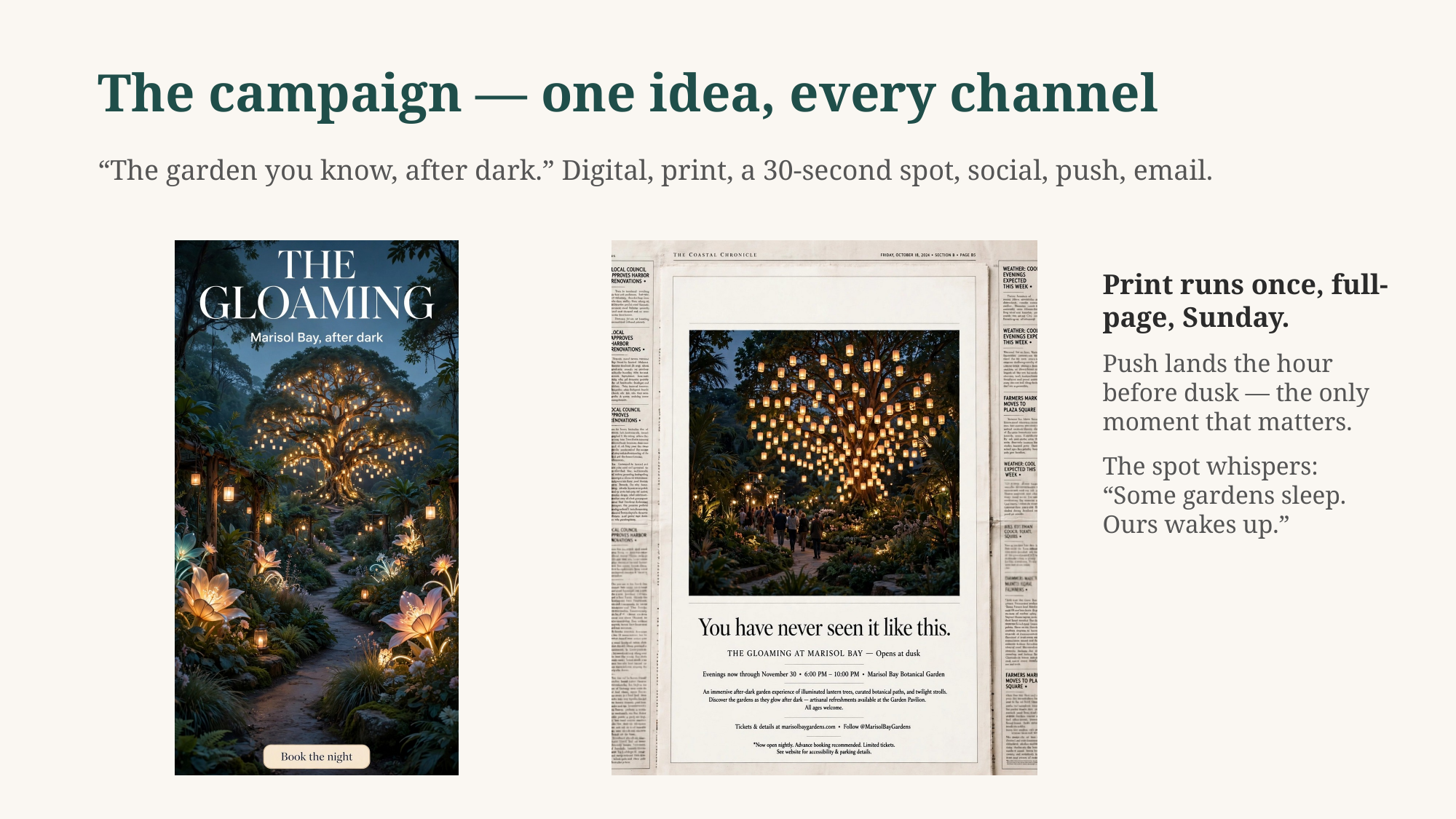
An experience nobody hears about is a rehearsal. The campaign for The Gloaming runs on one idea, pulled straight from the strategy: the garden you know, after dark. Every piece below is written the way I’d write it for a real launch — same voice, same promise, sized for its channel.

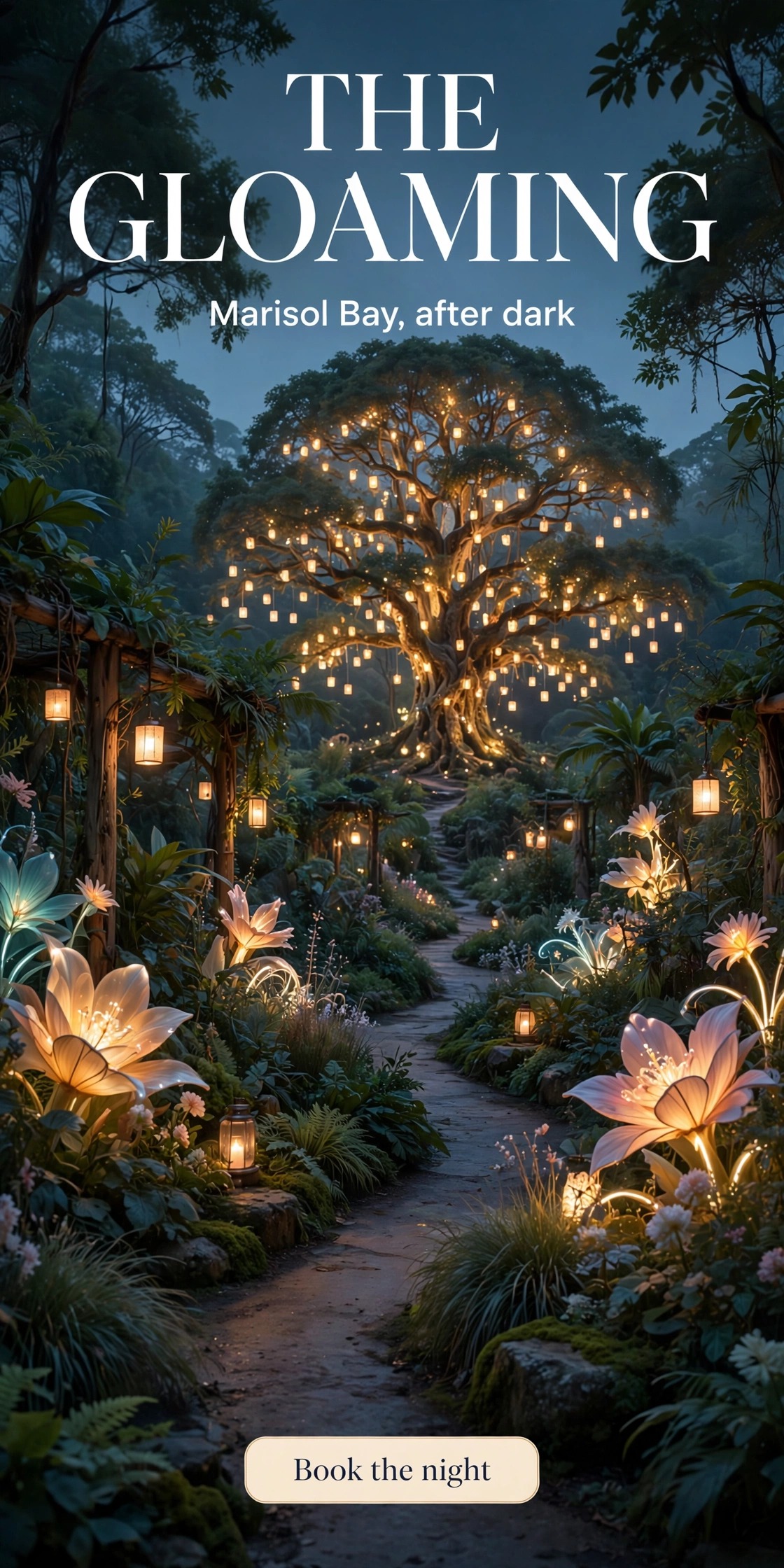
Digital ads (social and display). Visual: the hero path at blue hour, lantern tree glowing in the distance. Headline: “The garden, after dark.” Body: “Marisol Bay as you’ve never seen it — a story you walk through, lit one lantern at a time.” CTA: “Book the night.” A second version for locals leads with the habit, not the spectacle: “Your garden has a night shift now.”

Print — full-page newspaper ad, Sunday edition. One image, almost no copy, because the paper’s reader is the garden’s core audience and restraint reads as confidence. Headline: “You’ve never seen it like this.” Small print: “The Gloaming at Marisol Bay. Opens at dusk. Thursday–Sunday.” The ad runs once, big — a single full page says more than six weeks of quarter-pages.

Video — a 30-second spot, cut to 15 and 6 for social. It opens on the garden in flat afternoon light, ordinary and familiar. A voice, almost a whisper: “Some gardens sleep.” The light falls. One lantern lights, then a path, then the whole garden wakes — glowing botanicals, the lantern tree, guests arriving at the water chapter. Voice: “Ours wakes up.” End card: “The Gloaming at Marisol Bay — opens at dusk.”

Social posts — written in the garden’s own voice, never the marketing department’s:

  • Teaser (two weeks out), a photo of one unlit lantern: “Something’s about to wake up. 10.17.”
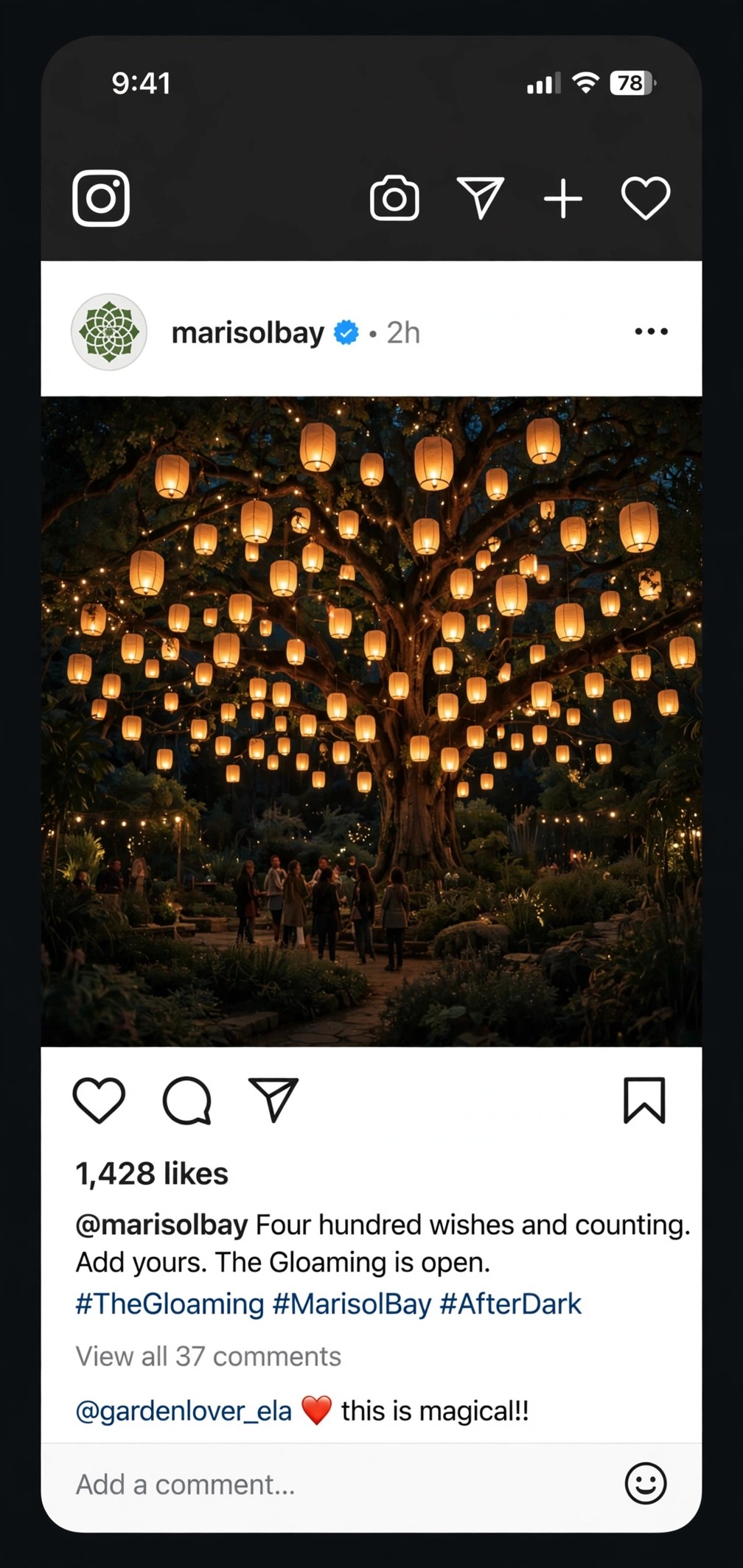
  • Opening night, the lantern tree mid-glow: “Four hundred wishes and counting. Add yours. The Gloaming is open.”
  • The regulars’ post, mid-season: “Same garden. New chapter. The Water Chapter got quieter and stranger and we think better. Come see.”

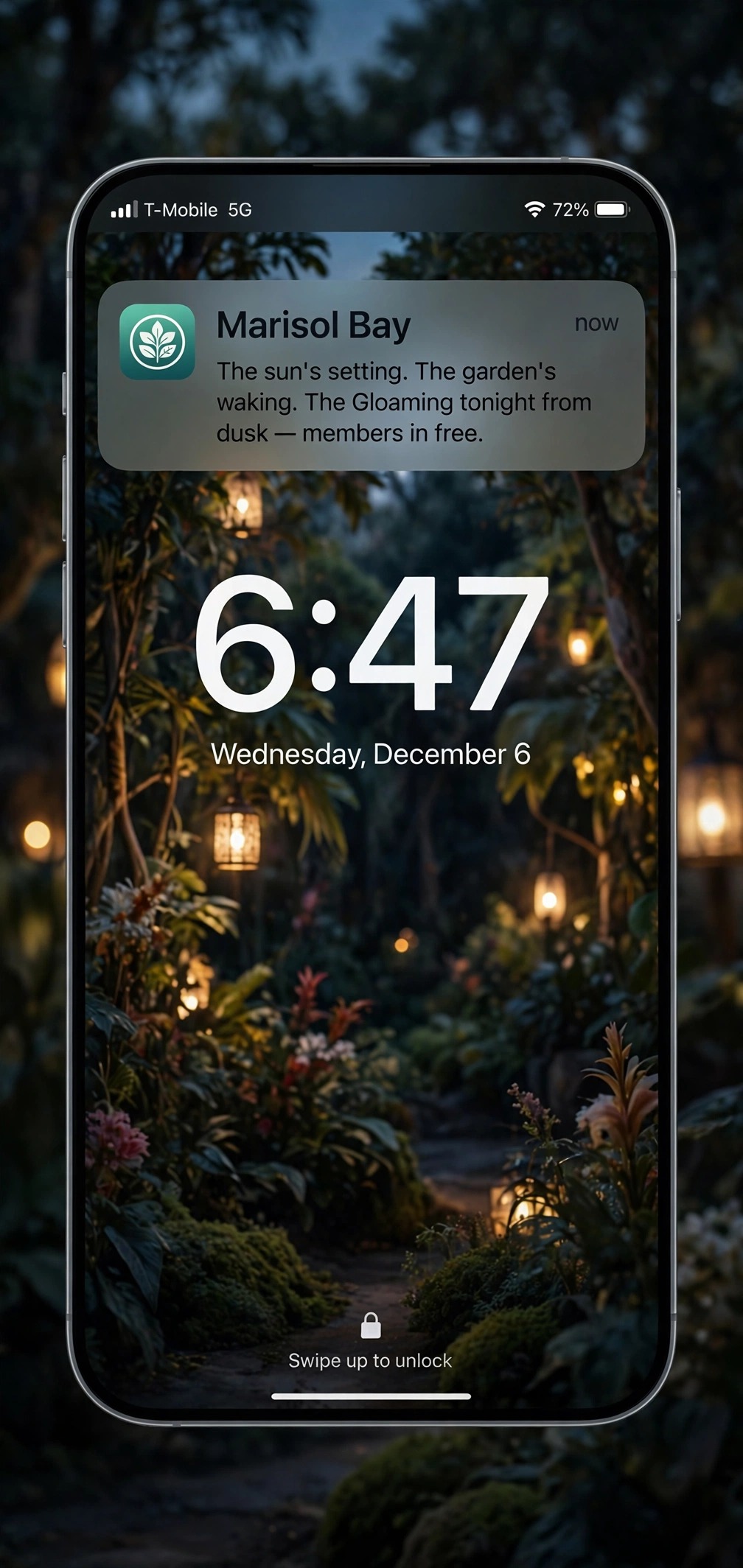
Push notifications — for the garden’s app and member list, timed to the only moment that matters, the hour before dusk:

  • “The sun’s setting. The garden’s waking. The Gloaming tonight from dusk — members in free.”
  • “Rain check on last night’s clouds: clear skies tonight, and the fireflies got the memo.”
  • “Last weekend for the Autumn chapter. The lanterns come down Sunday.”

Email — the launch note to the member list. Subject: “You’ve never seen Marisol Bay like this.” Preview text: “It opens at dusk.” Body, in full: “You’ve walked these paths a hundred times — in daylight. Starting October 17, the garden stays open after dark, and it becomes a different place: a story told in lantern light, chapter by chapter, from the first dark to the lantern tree to the quiet of the reflecting pool. Members see it first, October 15. Everyone else, bring someone you like

Sample 10-second spot

Sample Booking Page

Sample Print Ad

Sample Push Notification
Sample Social Post

9. Launch — soft open, honest eyes

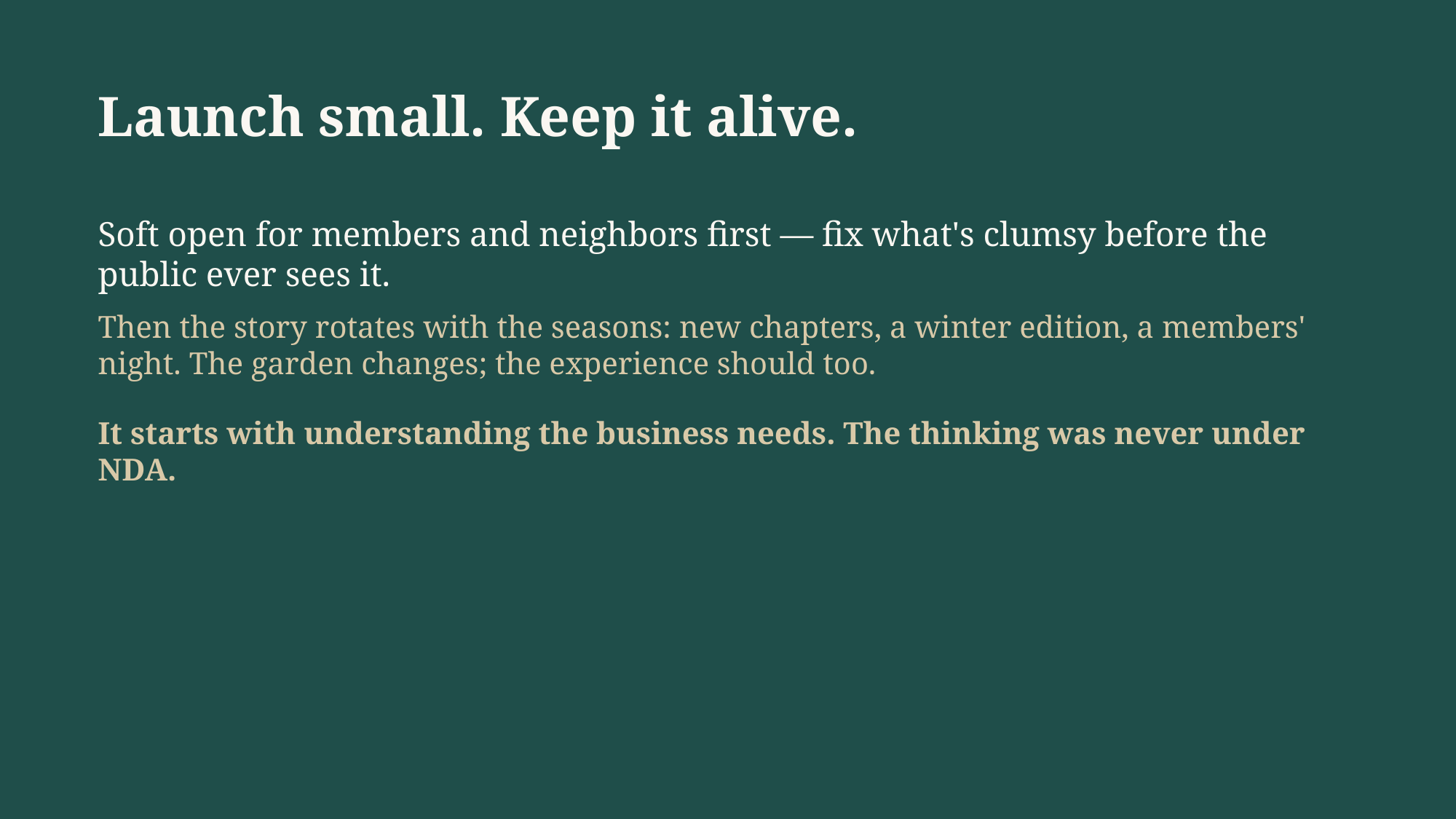
I’d open The Gloaming the way I’d open anything: small first. A members-and-neighbors preview weekend, staff walking the path as guests, and me standing at the two or three spots where I expect trouble — the transition into First Dark, the queue at the Lantern Tree — watching what people actually do instead of what the plan said they’d do. Then a short fix list, made while it’s still cheap: path lighting nudged, a chapter re-timed, signage cut in half. Launch isn’t the finish line; it’s the first honest read of the work.

10. Beyond launch — keeping it alive

A nighttime experience that never changes becomes a screensaver. The Gloaming is built to move: the story re-chapters with the seasons (spring bloom, summer fireflies, autumn harvest, a quiet winter edition), the Lantern Tree’s wishes are retired and renewed in a small ceremony each season, and one chapter a year is handed to a guest artist from the community. My job after launch is the same as before it — walk it, watch the guests, listen for the moment the story stops landing, and fix that chapter rather than repainting the whole garden.

The same process, on other kinds of projects

Marisol Bay is a place, but the process isn’t a placemaking process — it’s the order I work in on everything. Watch it flex:

  • A product launch: the business need is a market that doesn’t exist yet. The “concepts” are positioning routes, the name carries the strategy into the press release, and the campaign and the keynote are the same story told twice.
  • An internal program — training, onboarding, a company-wide initiative: the audience is employees, the “guest path” is their first ninety days, and the pitch is to the executives who fund it. Same stages, same discipline.
  • A brand refresh: the strategic conversation is about what the business became while its brand stood still. Concept concepts are identity directions; the launch is internal before it’s public, because employees have to believe it first.
  • A content or editorial initiative: the chapters are a season of stories, the lantern tree is the one franchise piece everything else hangs on, and “beyond launch” is the editorial calendar.
  • A retail or guest experience: the path is literal again — but the business need, the naming tests, the team casting, and the soft open work exactly the same.

Different industries, different deliverables — the sequence doesn’t change: business needs, strategy in a sentence, honest options, a name that carries it, a pitch that recruits, a team cast on purpose, a launch watched with honest eyes, and a plan for what happens after.

What this adds up to

It starts with understanding the business needs. Then strategy, in one sentence. Options with honest downsides. A name that carries the strategy. A pitch that recruits believers. A team cast on purpose. A story guests walk through, a campaign that sells it before it opens, launched small and kept alive. That’s the process behind everything in my real portfolio — the work itself is under NDA, but the thinking never was.